Tuesday, November 29, 2016

IT IS A NEAR CERTAINTY PIZZAGATE 1S 100 % LEGIT,SOROS FINANCED RECOUNT LAWYER

By Jim Stone
Nov 29 2016

Homes burned, trees unhurt

An old "snack eating friend" sent the following:


"Jim, check the aerial photos of the burned homes in Gatlinburg, the trees all around the houses that are burned down still have multi colored fall foliage on them. How can a wildfire burn a whole neighborhood to the ground but leave the majority of the trees un-burnt? Something fishy going on here. From your transmission shop owner friend in Bako"

My response: If you read the report about this (down the page a ways) I go over how the wood framed construction was intended to burn like that. If the foliage is still on the trees, it proves not everything was as "dry from the drought" as stated. It might have been dry enough for grass and brush fires, but not canopy type forest fires. All you need to do is get one wood framed house burning without attention, and the others around it will get hot, catch a spark, and burn also. Thanks for writing, and I am happy to know you are still out there!

It is a near certainty Pizzagate is 100 percent legit.

I am bumping to the top what I have completely confirmed is 100 percent legit.

Podesta brothers near perfect match for police sketch of Madeline McCann child snatchers

Police sketches are created with software that is fed descriptions from witnesses of what people looked like. This most certainly nails the Podesta brothers as child snatchers as accurately as could ever be done with a "no original photo" render of what people looked like.


Now that some new info is coming out, I am going to run with these photos, which I have had for a while.


Ok, so why would I post this? Because in a report farther down this page I discussed the death of Monica Petersen, who was investigating a child snatching ring being run under the cover of a fake gold mine in Haiti by Hillary Clinton's brothers, and Monica got arkancided last week. It is now fully confirmed that Monica was investigating Hillary's family in Haiti and was onto something, most likely linking to Comet Pizza, Hillary Clinton, the Podesta brothers, and DEFINITELY child smuggling conducted by Hillary's family all together in one neat little package, and then she died. She was in her 20's.[I have something on this Monica Peterson/Haiti/Clinton/Death that I will be posting next after I go through it DC]


It is suspected that she tied it all together, but did not live to tell about it. The agency she worked for confirmed she operated under cover and had conducted a two year investigation, got onto something big, and died. They confirmed it during a memorial service during a live stream from Haiti on Friday.


I finally posted the Podesta brothers police sketch photo (I have had it for a while) because now it appears that the Podesta brothers were in Portugal the day a little girl named Madeline McCann went missing while on vacation from Britain in 2003, and were confirmed to have been within a mile of that disappearance which is to
this day unsolved. With the Podesta E-mails being what triggered the entire pizza gate pedophile bust, Hillary's brothers running a child smuggling ring in Haiti with the subsequent death of the investigator that was onto it, the Podesta brothers obviously being featured in a police sketch of a child disappearance in Portugal on the day they were there, well, things are starting to unravel. Hillary herself said that "if Trump gets elected we're all going to jail," and it appears there might be significant substance to that statement.

NOTHING has changed on the recount in Pennsylvania

I was 100 percent right. Jill can't request a recount. She did it better than I thought she would, but is so far out of whack with the timing it is hopeless. Additionally, there was no voter fraud that did not favor Hillary. Pennsylvanian election officials are saying there is no evidence of fraud whatsoever. Pennsylvania is absolutely crucial to flip. It will not be flipped. It will also not be stalled. Pennsylvania is the hang mans noose on the entire deal.


Jill has to do something because she collected the money, but you can cry all you want and nothing comes back from ashes once totally burned.

My big worry is that George Soros has a spoiled three year old and/or chimp and definitely psychopath intellect that just can't accept no for an answer. He is very dangerous. And I have little doubt he'd do something heinous for revenge, and that he might already be burning Gatlinburg.

Keep your eye on the ball, and not Gatlinburg. Nail every last detail you can about the attempted election steal because the only possible way they can do anything is via completely overt paid off corruption.

Gatlinburg is burning to the ground

This could provide the media cover needed to distract Americans in the middle of an election theft

My suspicion is it was Soros paid rioters / operatives that set the fires. The MSM is blaming winds, drought and downed power lines but I do not buy that especially since they are proven fake media that serves the agenda of the elite.. According to people discussing this online, people who live there, 30 percent of the downtown area has burned already with no end in sight, hundreds of homes have burned, and thousands of resort cabins have burned. That is unspeakably huge. And there is not a peep about the scale of this in the MSM yet (6AM CST). Either they have a motive to keep quiet if they are not saying it like it is or they have not woken up yet.


As I have said all along, the wooden construction in the U.S. is going to be very bad for the American people. For almost 100 years it was against all codes to build a house out of anything but wood (brick homes had only a facade supported by wood that was required by code to collapse if the wood was gone) and the only purpose was to make a Gatlinburg type fire possible if the elite ever decided to ditch the country and render the American people helpless. This madness with wooden homes is repeated nowhere else in the Americas except Canada, another nation the elites would love to ditch.

Americans are in a very weak position. No one even realizes that if it comes down to war, all the elite have to do is get 15 houses burning at once in different places, which will overwhelm the fire departments and if you don't put a house fire out, in most areas that will chain reaction to all the other surrounding houses. The whole city will burn to the ground while the fire departments save 20 houses. That would stop an armed rebellion in it's tracks. I strongly believe this is the final insurance the elite have against the second amendment. South of the border, no one worries about fire. America was definitely set up for catastrophe on purpose.

FOLKS, IF THE MSM SUDDENLY SWITCHES TO HOW HORRIFIC GATLINBURG IS, DO NOT TAKE YOUR EYE OFF THE BALL - THE ELECTION THEFT, BECAUSE SOROS ABSOLUTELY WOULD BURN AN AMERICAN CITY TO THE GROUND TO DISTRACT THE PUBLIC WHILE THE NATION IS STOLEN. That's NOTHING for a filth demon of his caliber to do and he has the funds and the people to do it, along with the media control required to get away with it.

Nov 28 2016

Jill Stein sued for perjury in Wisconsin recount!

Green party journalist and radio host Don DeBar alleges that the false statements may have induced the state to fraudulently conduct a recount and caused thousands of people to donate a reported sum of $6 million to Stein's effort. DeBar has filed a lawsuit for fraud and perjury against Jill Stein. SEE THIS

GEORGE SOROS FINANCED RECOUNT LAWYER!

George Soros has his key attorney on the job! SEE THIS

PENNSYLVANIA REJECTED STEINS RECOUNT REQUEST BECAUSE AS I SAID SHE IS TOO LATE, SO I AM GOING TO LET GO OF THE LAST DETAILS:

I said I'd say it at 10 PM, but this is the TOTALLY UN SPOKEN OF road block that would have killed her efforts no matter what:


1. Any candidate running for a position of power, except a level 1 candidate (which is city level) in Pennsylvania CANNOT CALL FOR A RECOUNT OF THEIR OWN ELECTION. The only way it can happen is for an individual who never ran for office to file, and THAT INDIVIDUAL must submit a petition for a recount that has NO FEWER THAN 25,000 HANDWRITTEN SIGNATURES.

HA HA HA HA HA!. Not going to happen. Game OVER. And it was game over a week ago, no recounts can be called AFTER THE 23rd ANYWAY. I am right about this NO IFS OR BUTS, and I waited until later in the day to put this up because I wanted it to be irrevocably hopeless. It is SIMPLY TOO LATE, AND JILL COULD NOT HAVE DONE IT ANYWAY, EVEN IF SHE WANTED TO.

Yeah she's got a lawyer working on it. GOOD LUCK. AINT GONNA HAPPEN.
I thought the final deadline was the 23rd. But the Washington Examiner says the 21st. I don't care. Either way it is game over for her anyway.


PART 4:THE TRUE HISTORY OF THE AMERICAN REVOLUTION

THE TRUE HISTORY OF 
THE AMERICAN REVOLUTION
Image result for images from THE TRUE HISTORY OF THE AMERICAN REVOLUTION

By Sydney George Fisher


THE AMERICAN REVOLUTION  
IV 
PARLIAMENT TAXES PAINT, PAPER, AND GLASS AND THEN 
ABANDONS TAXATION 

DURING the year after the repeal of the Stamp Act politics were comparatively quiet in the colonies. The Assembly of Virginia voted a statue to the king and an obelisk to Pitt, and New York voted statues to both the king and Pitt. Several of the colonies passed acts indemnifying those who had suffered in the Stamp Act riots. 

There was, however, one cloud in the sky. A clause of the Mutiny Act, passed at the same time as the Stamp Act, had required the colonial legislatures to provide the British soldiers quartered in America with barracks, fires, beds, candles, and other necessaries. This provision was now enforced as part of the remodeling of the colonies. The officers in command demanded their supplies. The assembly in New York voted part of the supplies, but failed to furnish vinegar, salt, and pepper. 

This disobedience on the part of a dependency was extremely irritating, even to a Whig ministry ; and an act of Parliament was promptly passed prohibiting the New York Assembly from enacting any law until it complied with the requisition for the soldiers. This was internal regulation with a vengeance, that Parliament and a Whig ministry should actually suspend the power of a colonial legislature. Yet the act was unquestionably constitutional, because the colonists themselves had admitted that Parliament had full control over them, except in the matter of internal taxation.

They now began to realize the absurdity of the ground they had taken, and to see that the colonial relation necessarily implied full power of Parliament over New York or any other colony. New York, however, submitted, obeyed orders, and everything remained comparatively quiet. 

A few months after the repeal of the Stamp Act the king and the Rockingham ministry disagreed, and on July 7, 1766, that ministry went out of office. William Pitt formed a new one, made up of politicians from the various cliques and factions of the Whigs, a most impossible and impracticable ministry, and as short-lived as its predecessor. 

Pitt was no longer the powerful statesman who had carried England through the great war with France and secured for her Canada and what seemed to be a worldwide empire. His health was broken and his nervous system shattered. He was afflicted with paroxysms of anger, could not bear the slightest noise, or even the presence of his children in the same house with him. He spent enormous sums of money in planting his country seat, " Hayes," and secluding himself within it. He sold the country-seat, but was so unhappy at parting with it that his wife bought it back for him. He required a constant succession of chickens to be kept cooking in his kitchens all day to satisfy his uncertain, but at times ravenous, appetite.* 
* Lecky, " England in the Eighteenth Century," edition of 1882, vol. iii. p. 121
In forming the new ministry he compelled the king to give him a title, and henceforth he is known as Lord Chatham. Within a few weeks after forming the ministry his health failed so rapidly that he had to be taken to the continent. He never afterwards exercised any control in the ministry of which he was supposed to be the head and within a little more than a year he retired from it altogether. But up to his death, in 1778, he would occasionally appear in the House of Lords to make those eloquent and pathetic appeals, from which our school-boys used to recite passages, denouncing the government because it would not withdraw all the troops from America, and by peaceful discussion persuade the colonies to stay within the empire.

As for the ministry he had formed, it was not his in any sense. On every question it pursued a course opposed to his policy and after extraordinary confusion and divisions it soon ceased to bear even the semblance of a Whig ministry,* for by successive resignations Tories were admitted until it became all Tory. Lord Hillsborough and Lord North were admitted to it ; and finally that extreme and thorough-going Tory Lord George Germain. The Whigs went entirely out of power, and for the remainder of the time we have a Tory government dealing with the colonies. 
* Lecky, " England in the Eighteenth Century," edition of 1882, vol. iii. p. 123, et seq
The constant changing of ministries at this time had not a little to do with the development of the revolutionary spirit in America. A ministry seldom lasted over a year. While there were the two great parties, Whig and Tory, they were strangely confused and split up into factions. Party lines were not distinctly drawn,+ There could be no consistent and steady colonial policy. Whig ministries used Tory methods and Tory ministries used Whig methods. The uncertainty, the shifting back and forth from severity to liberality, passing taxing acts and repealing them, was a vast encouragement to the colonial rebels. As our Revolution advanced we find party lines and policies in England becoming clearer, until towards the end they are quite distinct ; and in 1778 the ministry carried out a distinctly Tory policy.
+Ibid., pp. 110-114
As one reads in this period of English history how weak, divided, and headless every ministry was; how bankrupt and disturbed business had become; how violent the excitement and rioting over Wilkes ; how incapable the government was to keep ordinary civil order even in London, one cannot help smiling to think of the opportunities our ancestors had in this confusion. There has been no period since then when we could have broken away so easily. Luck was an important factor in the Revolution, and attended us from the beginning to the end. 

In the autumn of 1766 Parliament went to the country, and, as was naturally to be expected, the new election returned a body more determined than ever to remodel the colonies, It is difficult for any nation to endure a dependency where its sovereignty is not recognized. The colonists had compelled England to repeal an important law, and had brought about this repeal by violence, by withholding trade, by starving English merchants and workingmen. Could this be endured ? could it be possible that a set of inferior people in a dependency had such power as that? 

Observing the temper the house was in, Charles Townsend, Chancellor of the Exchequer, a whig, and a most brilliant but uncertain member of the patch-work Chatham ministry, announced, on January 26, 1767, that the administration was prepared to solve the American problem. This solution would render the colonies self 'sustaining, and relieve Great Britain of the expense of securing, defending, and protecting them. He knew, he said, a mode by which revenue could be drawn from America for this purpose without causing the heat and turmoil of the Stamp Act ; and for this hopeful announcement he was vigorously applauded on all sides.

His plan was nothing more than taking the colonists at their word on the distinction between external and internal taxes. They had said that they were willing to pay external taxes, so a bill was introduced laying a duty on paint, paper, glass, and tea imported into the colonies, and to be paid at their seaports in the exact manner which they had said was lawful and constitutional. 

It was also at this time that other bills were introduced creating commissioners of customs to reside in Boston, strengthening the jurisdiction of the admiralty courts, and taking other vigorous measures to suppress American smuggling, as already described in a previous chapter. This patch-work Whig ministry felt as strongly as the Tories the necessity for remodeling and reforming the colonies. 

The paint, paper, and glass act was a great landmark in the Revolution, and wrought a great change of opinion. The colonists were fairly caught in their own argument. These new taxes were external, and, therefore, constitutional. At the same time they were laid on articles of such universal use, imported in such large quantities from England, that they would be paid in the enhanced price of the articles by all the people all over the country just like the stamp tax, and so were as much an internal taxation as the stamp tax. The colonists could only weakly argue against them that they were purely for raising revenue, and not for the regulation of the commerce of the empire. 

But although they were as internal in their effect as the stamp tax, they could not be resisted, as the stamp tax had been resisted, by simply not using the stamps. These taxes were collected at the seaports by the authority and force of the British, navy and army and a host of new revenue officers. If the articles were imported, the taxes would usually be paid, and the articles were of such universal use that it was difficult not to import them.

Petitions, resolves, and remonstrances were again sent to England, and the associations for suspending importations were renewed ; but it is noticeable that there was no rioting. In fact, the colonists were acting in a rather subdued manner. They hardly knew what to think. The next step was a serious one. They must adopt new political principles. Their leaders were holding them in check. A town meeting was held in Boston to discountenance rioting, and Otis urged caution and advised that no opposition should be made to the new duties. On the 20th of November, 1767, when the taxes went into effect, the people were remarkably quiet.* 
* Barry, " History of Massachusetts," vol. ii. pp. 340, 341
Their petitions, letters, and public documents are full of the most elaborate expressions of loyalty and devotion. The famous petition which Massachusetts sent to the king in January, 1768, is apparently the perfection of simple hearted unquestioning loyalty. Knowing what was in their hearts, it is most amusing to read the long-drawn-out humble submissiveness of their words. There is no bold arguing against the right to tax. They merely beg and beseech to be relieved from these new taxes. If they cannot be relieved from them, then they can only " regret their unhappy fate." They repeat the old unfortunate admission of the Stamp Act Congress that Parliament has superintending authority over them, but instead of adding the exception of internal taxation, they have a new exception, which they state by saying that this supremo authority extends to  "all cases that can consist with the fundamental rights of nature and the constitution." Those words," fundamental rights of nature," were a new way of limiting the authority of Parliament and significant of what was soon to happen.

Glancing at the documents sent out by the other, colonies, we find another idea obtruding itself. They ask for a return of the conditions and privileges they had enjoyed before the French War closed in 1763; the old days when the French in Canada prevented any remodeling or reform by England. This request for a return to that happy golden age became a watchword in the patriot party. 

In the next month, February, 1768, the Massachusetts Assembly sent to all the other colonial assemblies a circular letter, very cautiously worded, and arguing the subject in a quiet way. There is nothing about external and internal taxes ; but the recent duties on paint, paper, and glass are said to be infringements of their natural and constitutional rights, because such duties take away their property without their consent ; which is simply a roundabout way of saying that no taxation without representation, and the doctrine of consent, must now be applied to external as well as internal taxes. 

It is to be observed that they say that the duties are infringements of their natural and constitutional rights. A year or two before it was only their constitutional rights ; now it is also their natural rights. They are broadening their position to meet the new conditions. Massachusetts also said in the circular letter that the doctrine of consent was an "unalterable right in nature ingrafted into the British Constitution." This was altogether a new way of looking at the British Constitution, to "ingraft" upon it a right of nature against the will of Parliament and the English people ; and these rights of nature will soon have to be considered in a separate chapter.

The Massachusetts circular letter, of course, insists strongly that it is impossible that the colonies should ever be represented in Parliament ; and it declares in all seriousness that the colonists are not seeking " to make themselves independent of the mother country." In short, they are just dear, good children, who are so devoted to mother England that they will show her how to remodel her constitution. 

The British government, however, was not in the least deceived. They very naturally regarded this letter as " of a most dangerous and factious tendency, calculated to inflame the minds of good subjects in the colonies." The chief object of the letter had been to promote union among the colonies, unite them in opposition, and encourage a reciprocal expression of feeling. The government quickly saw this, and there was an unsuccessful attempt to have Massachusetts rescind the letter.* This caused an irritating controversy, which has been most voluminously described in many histories, but into the details of which we have not space to enter.[I have to say I am a bit troubled by this the author implies that this is a true history of our revolution, yet then says he does not have the space to go into detail about what he admits caused a controversy, so it just makes me more aware that the author has a bias and agenda to spin this 'true' history in a certain direction DC]  
* Paul Bevere, patriot, silversmith, engraver, and lover of saddlehorses, celebrated the refusal of the legislature to rescind by making a handsome silver punch-bowl, inscribed,  To the Memory of the Glorious Ninety-two Members of the Honorable House of Representatives of the Massachusetts Bay, who on the 30th of June, 1708, voted not to rescind.
It has been commonly said that the attempt of the government to have the letter rescinded was unwise because it was practically a denial of the right to petition, and made the colonies more rebellious than ever. But the ministry were in an awkward predicament. They saw that the colonies were evidently moving off. There was a powerful rebel party at work among them. Should the government stand still and let them go ? 

The most serious provision of the paint, paper,and glass act remains yet to be mentioned. The colonists had objected to the Stamp Act because it was understood that the revenue from it was to be devoted to keeping an army among them. They were also unalterably opposed to any system by which revenue raised from them was to be turned generally into the English exchequer. The paint, paper, and glass act was intended to obviate both of these objections. The revenue raised from it was to be spent entirely on the colonies themselves in maintaining among them civil government and the administration of justice. There was to be a colonial civil list, as it was called, and hereafter all governors, judges, and other colonial executive officials were to receive fixed salaries paid by the crown out of the revenue raised by the duties on paint, paper, glass, and tea. The old system of the assemblies securing the passage of their favorite laws by withholding the governor's salary, and of controlling the judges in the same way, was to cease. There was to be no more bargain and sale legislation; but in place of it orderly, methodical, regular government. 

This, as previously shown, struck at the root of what the colonists considered their system of freedom. If they could no longer control governors and executive officials through their salaries, they could no longer have their favorite laws. They would become mere colonies, compelled to take what was given to them and to do as they were told. 

The first man to come forward with a popular and encouraging statement of the colonist side of the controversy was John Dickinson, a young man of thirty-five, a Quaker, and a lawyer of considerable practice in Philadelphia. He had been for some years more or less concerned in politics ; had been a member of the Stamp Act Congress, and had drafted several of its documents.

He seems to have understood that the arguments thus far published were too brief and general. There was not enough of detail in them. The aggressive or patriot party among the colonists needed more light and were not sufficiently aroused. He accordingly wrote for one of the newspapers a series of " Letters from a Farmer" which accomplished his purpose most admirably. They awoke the colonists with a bound. The title was also fortunate, for the farmers were by far the largest and most important class in the community. 

His opening sentence was captivating. "I am a farmer," he said,  "settled after a variety of fortunes near the banks of the Delaware in the province of Pennsylvania," His farm was small, his servants few and good ; he had a little money at interest ; he asked for no more. 

There were twelve of these letters by Dickinson published in the Pennsylvania Chronicle between December 2, 1767, and February 15, 1768. They were quickly copied in most of the other colonial newspapers, reprinted in pamphlet form in numerous editions in America and England, and translated in France. They caused the greatest excitement among our people. Town meetings, societies, and grand juries sent votes of thanks to the author. They toasted him at public dinners, and wrote poems and eulogies in his honor. At the same time we must remember that these letters were also attacked as going entirely too far and " calculated to excite the passions of tiie unthinking."
* "Life and Writings of Dickinson," vol. ii. p. 280.
They enlarged in detail on the danger of losing control of the salaries of the governors. They showed the full meaning of Parliament's suspension of the legislative power of New York. They showed that if Parliament could suspend the functions of a colonial legislature, it was omnipotent in its control of the colonies. Dickinson was bold enough to answer the argument that England was too powerful to be resisted. It is also significant that he describes as a warning to the colonists how Ireland had lost her liberties. 

He took the new ground of rejecting all authority of Parliament, and at the same time tried to make it appear that there was no change from the old line of argument. He kept all the old arguments going, so as to conceal the new movement. He clung to the old absurdity of allowing Parliament to regulate the commerce of the colonies by duties which should not be for revenue. This effort to conceal the change of ground renders a great deal of his reasoning very obscure to a modern reader.* But the patriot party understood him- Englishmen also understood his purpose and saw what was coming,+ 
* Franklin, who was in England at the time, was puzzled by this obscurity. "I know not what bounds the farmer sets to the power he acknowledges in Parliament to regulate the trade of the colonies, it being difficult to draw lines between duties for regulating and those for revenue ; and, if Parliament is to be the judge, it seems to me that establishing such principles of distinction will amount to little. 33 "Life and Writings of Dickinson," vol. ii. p. 281. 
+Critical Review, xxvi. 62; "Life and Writings of Dickinson," vol. ii. p. 282.
In this same year, 1768, more strenuous efforts than ever were made to suppress smuggling. On June 10 there was the riot over the seizure of the sloop "Liberty." In September men-of-war and transports loaded with troops arrived in Boston to keep order. The British officials in the colony had asked for these troops.# By September 30 Boston Common was covered with tents, and about fourteen men-of-war lay in the harbor, with springs on their cables, and their broadsides covering the town.
# The loyalists said that citizens also asked for them. " The Conduct of the Late Administration examined," p. 53, et passim.

The position was serious and very peculiar; for, as Franklin said in his criticism on Dickinson's Letters, the Boston people were in their resolutions and documents acknowledging subordination to Parliament and at the same time denying its power to make laws for them. 

The year 1769 opened with Parliament declaring in both speeches and resolutions that the colonies were in a state of disobedience to law and government, adopting measures subversive of the constitution and disclosing an inclination to throw off all obedience to the mother-country. This was unquestionably a true description of the situation ; and I cannot see that any good purpose is served by obscuring or denying it by means of those passages in the documents of the colonists in which they declare their " heartfelt loyalty" to Great Britain, disclaim all intention of independence, and acknowledge the supreme authority of Parliament. Those fulsome expressions deceived no one at that time, and why should they be used to deceive the guileless modern reader ? The patriot party made many such prudent statements, which were merely the nets and mattresses stretched below the acrobat in case he should fall. 

We find Parliament in this year directing that the governor of Massachusetts obtain " the fullest information touching all treason or misprision of treason within his government since the 30th day of December, 1767, in order, as the instruction went on to say, that his Majesty might have such offences tried within the realm of England, according to the statute passed in the thirty-fifth year of the reign of Henry VIII." 

The meaning of this, in plain English, was that a colonist suspected or accused of treason must not be tried in the colonies where any jury that could be called would probably acquit him as a matter of course. It seemed better to take him to England and try him there in the calm and impartial light of regular British administration. This measure filled the patriotic party in the colonies with the most violent indignation. They denounced it in every form of language ; and although no one was ever taken to England to be tried, it was enumerated in the Declaration of Independence as one of the causes of separation. 

It was natural that our people, who, under the restraining power of France, had enjoyed so much liberty that they scarcely understood what a colony was, should be indignant at this suggestion of transporting them for trial. On the other hand, the ministry wished to establish British authority in the so-called colonies ; the law of Henry VIII. was on the statute-book ; it had been used several times ; the Scotch rebels had been tried out of the country in which their crimes were committed ; so, also, the Sussex smugglers and the murderers of Mr. Park, the governor of the "Windward Islands. 

It afterwards also seemed necessary to prevent the colonists from trying in their courts British officials who might be accused by them of murder, when in their official capacity they were suppressing riots. They would be convicted as a matter of course. Provision was therefore made for taking such officials to England, or to another and more peaceable colony, for trial. This measure, like the other, was never enforced, but vigorously denounced by our people. There were no trials for treason in the Revolution, although England was on the verge of it several times. 

Meantime, the non-importing associations were revived, in the hope that they would be as successful as they had been with the Stamp Act ; and we notice now for the first time that force and intimidation were used to compel merchants and others to join these associations and refrain from importing. Thus the year 1769 wore away until November, when, before the non-importation agreements had had any great effect, the extraordinary and unexpected news was received that the Tory ministry had of their own accord decided to repeal the duties on paint, paper, and glass and leave only the duty on tea.* 
* Ramsay, " American Revolution," Trenton edition, 1811, p. 110 j Byerson, "American Loyalists,' 7 vol. i. p. 301; Hildreth, "United States," edition of 1880, vol. ii. p. 653; Bancroft, "United States," edition of 1883, vol. iii. p. 362,
In the spring they had been denouncing the colonial rebellion and preparing to punish traitors. In the autumn they had eaten their own words, and in effect complied with the request of the rebels. The small duty on tea was left standing merely to show that the right to tax remained, just as the Declaratory Act had been passed when the Stamp Act was repealed. This duty on tea would also, it was believed, be a test of the real sentiments of the colonists, and show whether or not they were bent on rebellion and independence under any pretext. 

During the following winter this promise of repeal was promptly fulfilled. The duties on paint, paper, and glass were repealed, and the ministry even went farther and abandoned all attempt to compel the colonists to pay for their defense or to maintain the troops stationed among them. What could have been more gracious, more friendly, or more conciliatory than this ? I cannot agree with those writers, both American and English, who hold that a conciliatory policy would have saved the colonies to England. 

We must remember that on this occasion Lord Hillsborough officially informed all the colonial governors that the ministry "entertained no design to propose to Parliament to lay any further taxes on America for the purpose of raising a revenue." This was in strict compliance with the colonial argument and with Dickinson's "Letters from a Farmer" that what America objected to was " taxation for the purpose of raising a revenue." The ministry had abandoned the revenue and abandoned the compulsory maintenance of the army. They could hardly have done more unless they had declared England the colony and America the mother-country. The colonies were put back very nearly into the old condition that prevailed before 1763. 

Lord Hillsborough's promise that no more taxes should be laid on the colonies was faithfully kept. The British Parliament never passed another taxing act ; and, when five years later actual warfare began, no one could say that the promise had been broken, for there had not been even an attempt to pass such an act. 

When we seek to discover why the Tory ministry made this sudden change, which was in effect an adoption of the Whig policy and Whig methods, we find that they had discovered that the new duties would not produce 16,000 per year, and that the military expenses in the colonies had increased to more than ten times that sum. The paint, paper, and glass duties being therefore a failure and an expense, causing great irritation, and England being already oppressed with debt, the ministry wished to compromise with the colonists and settle the dispute in a friendly way. They had been divided on the question, and, after long discussion of their differences, settled them in favor of the colonists. 

If we seek still farther to explain this change of front, we may account for it, as a great deal of subsequent conciliation or vacillation may be accounted for, by the fear of France, Her shadow was appearing. She was again coming on the scene. The colonists were threatening to appeal to her ; and the Boston Gazette of September 20, 1768 ; had openly made the threat.* Even without the threat it was obviously France's policy to take advantage of any open rupture or difficulty that England might have with the colonies. France wished to revenge her humiliation in 1763 and cripple England's power as an empire. This fear paralyzed all of England's action. It was an underlying influence of debates in Parliament and consultations of ministers. England must avoid if possible the forcing of the dispute to that extremity. 
* Holmes, Annals," vol. ii. pp. 177, 178.
But whatever may be the reasons, the important fact remains that in this year 1770 Great Britain withdrew the two great colonial grievances, taxation for revenue, and compulsory support of a standing army; and this event should not be obscured or placed in the background of historical narratives merely because it does not show sufficient tyranny or oppression on the part of England. 

The first and most important consequence of this conciliation was that among the patriot or rebel party England's prestige was gone forever. She had lost much of her prestige and vastly encouraged that party when she repealed the Stamp Act at its dictation ; and now she had given the finishing stroke,+ 
+ " Letters of James Murray, Loyalist," p. 170.
England, of course, lost no prestige among the people afterwards called loyalists, people un-Americanized, inclining strongly towards England by taste and associations, and not inspired with the passion for ownership of the country in which they lived. These people accepted the repealing act in the spirit in which it was offered, as redressing grievances and tending to secure the colonies within the empire. 

So very conciliatory was the repealing act and the promise of the ministry, that it had a quieting effect on all parties and put an end to excitement and turmoil for three or four years. The moderates in the patriot party were willing to let well enough alone, and the small duty on the one item of tea did not bother them any more than the old Declaratory Act. In truth, the extreme radicals of the Samuel Adams type had nothing with which to arouse the moderates. The agitation business was at a low ebb. 

Within a few months, however, an accident occurred which could be used, and was used for a time, for purposes of excitement. It was one of those accidents which, in strained relations between independent nations, often precipitate a war. 

The ministry had not thought it a necessary part of conciliation to withdraw the troops from Boston ; and it is difficult to see how they could properly have withdrawn them. The lives of the customs officials in that town had been threatened by the mobs, and were not safe ; and the troops and war-vessels had been asked for, and sent, for the purpose of protecting those officials as well as to assist them in enforcing the navigation laws. 

The ministry could not very well abandon the enforcement of those laws. They had decided to stop smuggling, and had started to stop it. They could hardly draw back from that undertaking without surrendering completely to the colonists and abandoning the little that remained of British authority in America. Moreover, the colonists had admitted that such laws regulating trade were constitutional. 

The contest and the strained relations were now confined to Boston. The rest of the colonies were quiet and had no particular grievance; and the contest itself had now returned to the old subject of smuggling. 

The soldiers in Boston were extremely irritating; not only because they were swaggering and offensive after the British manner, but because Massachusetts was entirely unaccustomed to anything of that sort. If she had always been a real colony, accustomed to supervision, her people might have treated the military occupation as a small matter. British colonies often have considerable bodies of troops stationed in them. In our own time in Canada we have often seen the people quietly acquiescing in the presence of the red-coated regiments which caused such frenzy in Massachusetts. But Massachusetts had at one time enjoyed semi-independence, and the presence of troops to enforce laws which she had disobeyed for a hundred years, and grown rich through disobeying, was almost unbearable. Her people felt towards those troops very much as they would feel today if Boston were occupied by a foreign soldiery. 
Image result for images of the boston massacre
It was naturally to be expected that anything like ill conduct by the soldiery would be exaggerated by the people and used by the patriot leaders to stimulate their resentment. There is no question that some of the more radical and fiery spirits were constantly exciting the townspeople to quarrel with the soldiers. Both men and boys made a constant practice to insult the "bloody-backs," or " scoundrels in red," as they called them ; and they would shout at them, "lobsters for sale." The soldiers in their turn had their insults for the " mohairs," or " dung-hill tribe," as they called the colonists. The soldiers were often arrested by the local magistrates, whom we may be sure were not lenient with them and the colonists complained that the officers screened their men from punishment. 

On the 2nd of March, 1770, a soldier asking for employment at Gray's rope-walk was refused in. coarse language. He insisted on having a boxing-match with one of the workmen, and was beaten. He returned with some companions and was driven off, and a larger number coming to fight with clubs and cutlasses were also driven off. On the night of the 5th there was much disturbance in the streets ; the soldiers were swaggering and threatening, and the citizens and boys replying to them in language equally abusive. The mob, armed with clubs, balls of ice, and stones inside of snow-balls, finally pressed upon a picket guard of eight men, daring them to fire. The soldiers restrained themselves for some time, until one, receiving a blow, fired his musket, and immediately six of the others fired. Three citizens were killed and eight wounded.* 
*John Adams, "Works, vol. ii. p. 229; Ramsay, "Colonial History," vol. i. pp. 364, 365 ; Holmes, " Annals," vol. ii. pp. 166, 167 ; Hildreth, u History of the United States," vol. ii. chap. xxix. pp. 554, 555
There was at once great excitement in the town. The bells were rung; the cry was spread, "The soldiers are rising," and many believed that a general attack by the citizens on the soldiery was narrowly averted. The next day a town meeting was called. A committee, of which Samuel Adams was chairman, urged Governor Hutchinson to remove all the soldiers from the town to preserve the peace and prevent an attack by the people, who would soon be swarming in from the country. After some hesitation Hutchinson agreed that the soldiers should be sent down the harbor to the castle. This was, from one point of view, a wise and creditable expedient to prevent violence. But we must also remember that it was a yielding on the part of England to the demands of the colonists, with the redoubtable rebel Sam Adams at their head. 
Image result for images of the boston massacre
The captain of the guard and the eight men had been immediately arrested. They were turned over to the civil authorities of the colony, regularly tried, defended by John Adams and Josiah Quincy, and the captain and six of the men acquitted. The remaining two were brought in guilty of manslaughter, and slightly punished. This trial reflected the greatest credit not only on the jury, but on Adams and Quincy, who were patriot leaders; and the verdict of the jury showed that the soldiers had not been seriously to blame. But most of the patriot party seized upon the occurrence for their own purposes. They called it the " Boston Massacre," and Paul Revere prepared a colored engraving of the scene, calling it the "Bloody Massacre." They exaggerated it into a ferocious and unprovoked assault by brutal soldiers upon a defenseless people, and the eagerness with which this exaggeration was encouraged showed whither events were tending. 

The evidence taken at the trial has been published,* and contains all we really know about the event. It is worth reading as an astonishing revelation of the times, the anger and resentment of a large part of the people, the torrents of abuse and slang that were exchanged, the hatred of England and English control, and the readiness to destroy any symbol of that control. After reading the description by the witnesses of that night in Boston, one sees that the American communities could never be turned into modern colonies by the conciliatory policy, or any policy except some sort of extermination. 
* "The Trial of the British Soldiers of the Twenty-ninth Regiment of Foot for the Murder," etc., Boston, 1807. It reveals a great deal of local color, and discloses to us the Boston street boy of that day.
The government had been most lenient in surrendering the guard to be tried by a jury of colonists and in removing the troops from Boston, so that the "massacre" could not at that time be worked up into rebellion. The government had certainly not acted harshly. On the contrary, there had been so much yielding that the two regiments that had been sent out of Boston were ever afterwards ridiculed in England as the " Sam Adams regiments." 

The colonists quieted down. John Adams retired from politics and devoted himself to his profession. Except for the partially successful attempts to repress their smuggling, the people were very much in the same semi-independent condition as before the French War. The slight tax on tea, which had been left partly to show that Parliament was the supreme power and partly as a test to see how rebellious the colonists were, worked well enough, because the colonists did not mind it ; and continued to smuggle tea from Holland. 

There were strong indications that possibly the American problem had been settled, and that the colonies would remain colonies of the old smuggling kind, disregarding such laws as failed to please them. Violent efforts were made by the more radical to keep up the non-importation associations, but without success. One by one the Southern colonies and then Pennsylvania and the New England colonies and New York began importing all English commodities except tea. The protest which the extreme patriots made against this is instructive as showing the condition of parties. They declared that the spirit of liberty was dead. The students at Princeton, among whom was James Madison, put on black gowns, and Lynch, of South Carolina, is said to have shed tears over what he deemed the lost cause. 

This state of quietude lasted three years, to the great annoyance of men like Samuel Adams, who were bent on absolute independence. But most of the patriots were content that they could repeal acts of Parliament and order British troops out of a town.

to be continued...next...
THE TEA EPISODE


FAIR USE NOTICE


THIS SITE CONTAINS COPYRIGHTED MATERIAL THE USE OF WHICH HAS NOT ALWAYS BEEN SPECIFICALLY AUTHORIZED BY THE COPYRIGHT OWNER. AS A JOURNALIST, I AM MAKING SUCH MATERIAL AVAILABLE IN MY EFFORTS TO ADVANCE UNDERSTANDING OF ARTISTIC, CULTURAL, HISTORIC, RELIGIOUS AND POLITICAL ISSUES. I BELIEVE THIS CONSTITUTES A 'FAIR USE' OF ANY SUCH COPYRIGHTED MATERIAL AS PROVIDED FOR IN SECTION 107 OF THE US COPYRIGHT LAW.

IN ACCORDANCE WITH TITLE 17 U.S.C. SECTION 107, THE MATERIAL ON THIS SITE IS DISTRIBUTED WITHOUT PROFIT TO THOSE WHO HAVE EXPRESSED A PRIOR INTEREST IN RECEIVING THE INCLUDED INFORMATION FOR RESEARCH AND EDUCATIONAL PURPOSES. COPYRIGHTED MATERIAL CAN BE REMOVED ON THE REQUEST OF THE OWNER.

PART 4 of 4: THE TATE MURDERS WERE A FALSE FLAG AND THE GREATEST UNKNOWN SUCCESS STORY OF PROJECT CHAOS

The Tate Murders were a False Flag 
and the Greatest Unknown Success 
Story of Project CHAOS
Image result for IMAGES OF Sharon TATE in a wig on the set of Fearless Vampire Killers 
by Miles Mathis
You will best benefit yourself by keeping an open mind and forgetting most of what you have learned in the past. 

 Jay Sebring*


Part 8: 
the “Prisoners” 
In closing, let's bookend this investigation by looking at Manson one last time. We have seen that Sharon Tate wasn't where we thought she was for the past 40 years. Has Manson been where we thought he was? Here is a recent picture of Manson. 
Image result for IMAGES OF CHARLES MANSON
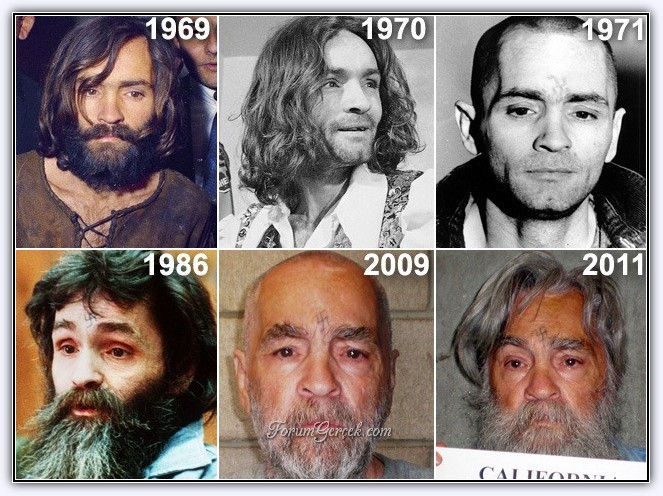
The date is right there for you. Do you see a problem? Prisons don't allow beards like that. Beards used to have to be trimmed to ½ inch, but since 1998 they have been disallowed in California State Prisons.  Manson was originally in Vacaville and San Quentin, but he was transferred to Corcoran in 1989, a California State Prison. So the question we should have is, “Is Manson really in prison at all?” Or do they just ask him to come in every couple of years so they can take his picture with a printed card? Ask yourself this: Do we have any evidence— evidence that wouldn't be easy to fake—that Manson is really living at Corcoran? If they can fake all these deaths, they can fake a few people being in prison. If you don't think so, I encourage you to study John Hinckley, who allegedly shot Reagan in 1981. You can find out the truth there without doing much research. Mainstream sources admit that Hinckley, the son of a rich friend of the Bushes, never went to jail, was being released into the care of his mother within a few years, and that during the last decade he has spent almost as much time at home as in the cushy psychiatric hospital. Since 2009, he has been given a dozen home visits of 10 days at a time. Do the math and you find that is 1/3rd of the year. He is also allowed to drive! Most people assume Hinckley is serving a life term, and they have always been wrong. Most people assume Manson is serving a life term. Are they right? We don't know. They make little movies about Manson every few years, and release some pictures, but as we have seen, those things can be faked as easily as a 15-second commercial for Rice-a-roni. Manson could be living in Big Sur in a house on the beach, for all we know. 
Related image
Another obvious problem there. Do you see it? Compare the 1971 to the 2009 photo. Manson has had an ear tuck on his right ear. Do you really think the State of California paid for or allowed an ear tuck? State prisons pay for necessary health care, but not for elective cosmetic (vanity) surgery. 

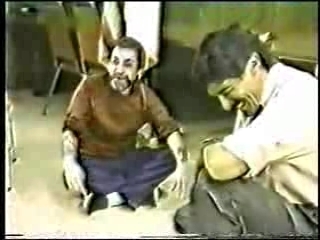
How many interviews has Manson done since 1970? Twenty, thirty, more? Don't you think it is odd that Manson has appeared with Nuel Emmons, Charlie Rose, Tom Snyder, Diane Sawyer, Geraldo, Ron Reagan, Jr., Penny Daniels, Heidi Schulman, Michal Ben Horin, and many others? I encourage you listen to all of them closely. For a start, go to the very first, his 1972 interview on San Quentin death row, which is ridiculous from the first frame. First we see Manson getting his dinner. Manson refuses his dinner and asks the server to give his steak to Mike next door. So they serve steak every night at San Quentin, I guess, and prisoners can request their meals be given to other prisoners? They expect us to believe this? Then, when the interview starts, the interviewer just sticks his microphone up to the bars. Do you really think journalists and camera crews are allowed to interview and film death row inmates inside the cell block? Of course not, which is why in future interviews they decided to bring Manson into an interview room of some sort, to make it look slightly more believable. The last thing Manson says in that first interview is, “I believe what I'm told to believe. Don't you?” They were fucking with us even then. They don't feel compelled to make these interviews believable—since they just assume the audience knows nothing about nothing—but they are quite willing to insert their own private jokes. As they are brainwashing you, they laugh and ask you if enjoy being brainwashed. 

Even after they moved the interview and camera crew into a private room in later films, the thing was still a farce, since level 1 prisoners like Manson are not allowed to talk to anyone except their attorneys, clergy, or law enforcement. This is the common rule in all state prisons across the country, and has been for decades. Anytime you see an interview with a convicted mass murderer/torturer, you should ask how such an interview is possible. 
Image result for IMAGES OF CHARLES MANSON in geraldo interview
I encourage you to watch again the 1988 Geraldo interview with Manson.It starts out with a pan of the room, and we see the film crew strolling around. One bored cop is by the door, not even looking towards Manson. Everyone, including Geraldo, appears to be suppressing a smile. Manson is wearing bluejeans and a brown shirt, and is sporting a longish beard with long hair. I paused there at 16 seconds into an hour-long interview, and I already knew it was fake. This is Charles Manson, folks: supposedly one of the most dangerous men alive. This is the guy who lunged over the court tables and supposedly tried to get at his judge with a sharp pencil. But here he is with Geraldo, and Manson has no handcuffs on, no security is near him, he is not wearing prison clothes, he is not shaved or shorn like a prisoner, and he is acting like he is in control of the script (which he may have been). He is ordering the cameramen around. They simply do not let level I prisoners do interviews like this. If Manson were who we have been told he is, he could kill Geraldo with one punch to the throat or one jerk of his chin. Instead, we see Geraldo leaning in, his head less than a foot away from Manson. They are literally knee to knee. No table is between them. We see Geraldo covering a chuckle at second 26. Anyone who thinks this is a real interview with a mass murderer has done too many acid trips themselves. 
Image result for IMAGES OF CHARLES MANSON in  Penny Daniels interview
The 1989 Penny Daniels interview  is also a flying farce, since Manson comes in wearing a wide-collar hippie shirt, dark sunglasses, Converse sneakers, and a beard that is at least 3 inches long. He's also still wearing his leather “thong” necklace. None of that is regulation prison attire. You may want to check Penny Daniels' bio and Wikipedia page. Although this is by far the biggest thing she ever did, it isn't mentioned. Manson walks into the interview room thinking he has an interview with someone from France. He is like some movie-star at Cannes who can't keep up with all his worldwide interviews. He should travel with a booking agent. He then tells the prison administrator who is present to sit down and shut up. He tells him he is just a “lockman” and that he doesn't have any power there. Very amusing theater, but no more than that. Outrageously unbelievable in every way. You also should notice that Manson's face and hands show no indication of the third-degree burns he was supposed to have suffered at Vacaville in 1984, when he was allegedly doused in paint thinner and set on fire. Third-degree burns require excision and always scar badly, but we see nothing like that. You will say the scars are beneath the beard, but beards don't grow over third-degree burned skin, especially not thick healthy beards like we see on Manson. Also see minute 8:40, where we see Manson's right hand very clearly. Doesn't look like a jail hand, since it is clean and well manicured. Also no scarring. Also, a gold pinky ring. Not allowed in jail. At 22:30 we see the left hand as well: no scarring. As smooth as a girl's hand. 
Related image
Manson does give away some information, though. He tells us he knew Lynette Fromme from before 1967. He tries to cover by saying he knew her in a dream, but he is obviously rattled for a moment, realizing he has said something he shouldn't have. According to the standard story, he wasn't supposed to meet Fromme until 1967, after he had been out of prison some months. This implies that Manson's earlier prison record may be faked or padded as well. Knowing what we now know, that doesn't take much believing. 

I also encourage you to listen closely to Manson's “Sneakyville” speech, reproduced several times on youtube. Do you hear a problem? Although the audio is pretty well synched to the video, that isn't Manson's voice. It sounds more like Henry Fonda or Peter Coyote. I don't know why they would replace the audio, since Manson is very able to do his own audio. Maybe they lost the audio. 

The Nuel Emmons “backporch interview” in 1979 is also ridiculous. First we have to ask, “Who in hell is Nuel Emmons?” Have you ever heard of anyone named Nuel? I found two other first names of Nuel on the internet, but they both looked fake as well. Nuel Emmons is another phantom, with no history other than his work with Manson. We have these interviews and a book in 1986, and other than that Nuel Emmons didn't exist. It looks like an anagram to me. I would say it is meant to be an anagram of Emmanuelson, which is both a lengthening of Manson and a reminder that Manson claims to be the son of God. Emmanuel-son. Nuel Emmons isn't a real person, it is just an alter-ego of Manson. 
Image result for IMAGES OF CHARLES MANSON in Michal Ben Horin,  interview
We see more theater in the later 1992 interview with Michal Ben Horin,  by which time they have lost any last sliver of respect for the whole charade. They dress the young female interviewer like Victor Victoria, and expect you to believe her real name is Ben Horin, as if she is Jewish or something. It is all an inside joke, and not even a subtle one. It was a toss up whether to name her Michal Ben Horin or Michal Ben Dover. Do a websearch, and you see she has no presence before or after 1992. We are to believe she has done nothing except that one interview 20 years ago. We do, however, get the continuation of the joke with another Michael Ben Horin, who is a more recent “terrorist” praying for the death of Ariel Sharon. 
Image result for images of Michael Ben Horin,
Get it? Ariel Sharon, Sharon Tate? And see how this Michael Ben Horin is given his own Charlie Manson beard, to go with his death-camp shirt and star? Hilarious, right? 

For more of the same kind of jokes, you can research John Aes-Nihil, which is the fake name of a fake director who supposedly produced the fake Manson Family Movies in 1984. These are faux home movies made to look like the Manson family shot the movies of themselves. They even made up reviews. One of them is, “Looks like the real thing,” signed Kenneth Anger. To get that joke, though, you have to know who Kenneth Anger is. Anger is a fake Crowley Satanist who made a lot of propaganda movies on the occult, homosexuality, and surrealism back in the 50's and 60's. But to understand what he was really up to, you simply have to look at the date of his first film Fireworks, which came out in 1947. Remember that date? That is year one of the CIA. Whenever you see Crowley or Satanism, you can substitute CIA or MI6 instead. Anger was one of the top guys at Lookout Mountain from the beginning, producing their “raciest” propaganda. So for Anger to be quoted as saying, “looks like the real thing,” is doubly and triply rich. They might as well have two thumbs up from Goebbels and Riefenstahl, “looks like first-rate agitprop to us!” 

Somehow, this fake person Aes-Nihil was also able to get a series of interviews with Manson between 1972 and 1979, which, like everything else, you can see on youtube. This despite the fact that we know he wasn't allowed visitors. In a 1975, in a telephone interview with Sandra Good, both Good and the reporter admit that Manson was not allowed visitors, much less interviews with filmmakers. Nihil is the Latin word for “nothing,” and Aes is the Latin word for “brass,” as in the phrase, aes alienum, “another person's money.” So Aes-Nihil translates as “money for nothing,” as in the Dire Straits song from 1985. Aes-Nihil probably is Kenneth Anger, but if he isn't, he is just another director at the still-busy Lookout Mountain Film Laboratory, aka Hollywood. 

Now maybe you understand why the people running these events decided to go ahead with 9/11 and everything since. By the late 1990's they could see that no matter how outrageous their stunts and jokes became, no one was catching on. Even the most revolutionary conspiracy theorists were clueless, missing everything. No one had even come close to figuring anything out, even though the perpetrators were leaving clues everywhere in plain sight, bigger every year. When people are so stupid they don't even know you are fucking with them, it isn't fun anymore. It isn't fun being a bad guy when no one even knows how bad you are. That is why they have graduated to 9/11 and Sandy Hook and everything in between. They need to be noticed. They need to be appreciated as bad guys. Just as I need my audience and you need yours, they need their audience. They need someone to get the jokes. Just as Moriarty needed Sherlock Holmes, these people need me. Even if I don't fully appreciate their sick jokes, at least I get them. I don't have to like them or even respect them, but it is important that I see them. No one likes to be fully invisible. Even the spooks don't like to be fully invisible. They like to get away with everything, but it is much preferable to be visible while you are getting away with it, don't you see? Any fool can get away with an invisible crime. It takes someone really clever to get away with a visible crime. Or this is the way they think. 

The latest Manson psy-op was in 2011, when Vanity Fair Spain did a radio interview with him. 
Image result for IMAGES OF CHARLES MANSON with   Star and Gray Wolf
This picture ran with the story. That's supposed to be Manson with Star and Gray Wolf, two “secretaries” who help him publish his ideas through ATWA—which stands for Air, Trees, Water, Animals. We are told he plans to marry the 25-year-old Star. 

They never quit. They respect your intelligence so little they continue the farce to this day. Level 1 prisoners are not allowed visits from strangers like this. They also aren't allowed radio interviews with Vanity Fair. If Manson were a real prisoner, he would be allowed to talk to his attorney, his immediate real family (by blood or previous marriage), or law enforcement. He is not allowed to pose for pictures with CIA agents posing as hippies. He is not allowed a beard. He is not allowed to wear a kerchief around his neck. He is not allowed the two rings on his left hand. He is not allowed to take a wife, and even if he were he would be allowed to talk to her only through plexiglas. He would not be allowed conjugal visits even from an original wife, and especially not from a new wife. 

And the whole ATWA website is just one more pathetic attempt to slander the environmental movement. Star looks like Susan Atkins (40 years ago), and now that Atkins is supposedly dead, they needed a replacement. Crazy girl actress of the hour, hired from SAG. 

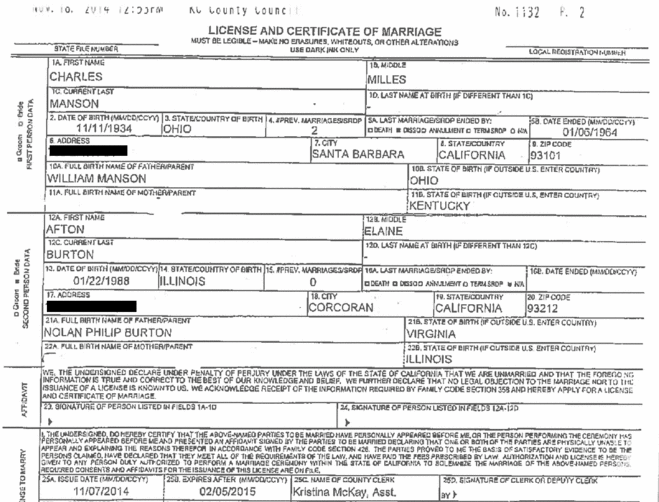
[Update, December 2014. They are going ahead with this wedding charade, although it wouldn't do Manson any good even if all this were real. He wouldn't get conjugal visits, so what's the point? Anyway, the Los Angeles Times has now printed the marriage license, giving us the latest clue. 
Image result for IMAGES OF CHARLES MANSON marriage license to Star
Apparently they are telling us Manson is living in Santa Barbara. It is his “fiancée” Afton that lives in Corcoran, according to the certificate. You will tell me they just accidentally switched them. Maybe, but I take it as their latest tipping of their hand to us. If you live in Santa Barbara, keep your eyes open. That guy you just thought looked like Charlie may actually be him.] 

This last bit of info lead us to ask who Charles Manson really was. If he wasn't the crazy ex-con we have been sold, who was he? Well, we saw above that Sharon Tate's dad was a colonel in Military Intelligence. Turns out Charles Manson's real father was also a colonel, , Colonel Walker Scott.. He had worked for the Baltimore and Ohio Railway, and was a member of the Elks Lodge. Manson's paternal grandmother's name was Gladys Kline. Scott allegedly died at age 44 in Ashland, Kentucky. 

The B&O Railway was at that time merged with the C&O Railway, under the control of Cyrus Eaton. Eaton was a protégé of John D. Rockefeller. He also likely had Intelligence connections, which we can see from his foundation of the Pugwash Conferences in 1957. These conferences on Sciences and World Affairs were put together after the Russell-Einstein Manifesto of 1955, both of which sought solutions to global security threats, including nuclear threats. In other words, it was all another propaganda project. 

The Elks are a Masonic-type lodge, probably allied to the Freemasons. The only difference is they can have alcohol on premises. The Elks were started right after the Civil War, and I assume they are an Intelligence front. 

The name Gladys Kline is almost certainly Jewish, and we can tell that by the first name as well as the last. You may be interested to know that Elvis' mother was named Gladys as well, and that she was also Jewish. See the Star of David on her original tombstone. Kevin Kline is Jewish on his father's side. 

Ashland, KY, is the home of two military bases. Manson's half-brother Walker Scott, Jr. was also a colonel, stationed at Sampson AFB in New York. Manson also had an aunt from this family, Mrs. Mae Cooksey, who lived in Long Beach, CA. She was married to Corporal Alton Bert Cooksey. He is also buried in Ashland, so we have to ask what they were doing in Long Beach. Well, the Port of Long Beach is one of the world's largest shipping ports—with a Navy presence as well—so Bert Cooksey was probably a technician there. This would have made him a Marine corporal, which connected him to the Navy, which may have connected him to Jay Sebring and Colonel Paul Tate. If that is true, that would give us only two degrees of separation between Manson, Tate, and Sebring. But regardless, we have seen that Manson's father and half-brother were both colonels, which is strange enough in itself. Also strange is that they never tell you that in the mainstream bios. 

Before we leave Manson, I draw your attention to a final anomaly on the marriage license above. Note that his birth date is listed as 11/11/34. That is curious for two reasons: one, 11/11 is a favorite number of Intel. They use it as a signal or as numerology in their events, along with 33 and 88. Two, the date is curious because it is wrong: the date listed on his mainstream bio is 11/12/34. 

Now let us move on to Susan Atkins. 
Image result for images of Susan Atkins.Image result for images of Susan Atkins.
The videos of Atkins are equally suspicious and absurd. I encourage you to watch her last words, in this video from ABCnews. Ask yourself this: is it common procedure to roll lifers into prison offices so that they can recite the Lord's Prayer for ABCnews? Or does this maybe look a little bit like the continuation of a scripted tragedy, the final act in a long-drawn-out and poorly written play? If that doesn't convince you, how about the picture above, which is a glamor shot of Atkins. She looks to be at least 35. Problem is, she was supposed to be in jail by the time she was 21. Do you think they do glamor shots for lifers? Look at her hands. They don't do fingernail polish in prison, and fingernails are not allowed to be long, for obvious reasons. Nice wig, no? Do you really think they do wigs in prison? Yes, I suppose to encourage prisoners to go incognito, so they can escape. Which brings up the fact that Atkins, like Tex Watson (see below), worked in a wig shop around the time she met Charlie.11 The CIA should have spread the jobs around better. Having Sebring set up both Watson and Atkins in wig shops looks mighty suspicious after the fact. Especially now that we know Paul Tate opened a hair salon in 1971. 

The red flags in the long Susan Atkins saga are legion, but just remember that Joseph Ball worked with Atkins after her arrest in 1969. Who is Joseph Ball? He was senior counsel on the Warren Commission, for one thing. Why was he giving counsel to Atkins, and who was paying for it? Atkins also skated charges several times like Manson. Although she pleaded guilty, her arrest for pot in 1968 led only to probation. Patricia Krenwinkel beat the same rap in Mendocino. Looks like they were being saved for their roles. Like Tex Watson—who we will look at below—and Leslie van Houten—who was a homecoming queen—Susan Atkins was a model highschool student, having been the captain of her swim team and a singer in the church choir. That was only one year before she became “Charlie's girl” and two years before she was supposed to turn into a witch, a torturer, and a multiple murderer. She was not the sort to drop out of highschool to become a topless dancer, and she didn't. She was recruited to play a part. Strange that we never hear from Atkins' highschool friends. They might tell you who she was recruited by, and exactly under what circumstances. 

For another red flag, I send you to minute 40:10 of this video.  Atkins and her attorney are being interviewed by reporters while still sitting at the courtroom table. She doesn't say much, but that isn't the point. She wouldn't be allowed to be interviewed at all, but especially not in the courtroom. No judge would allow reporters into his courtroom to interview an accused murderer. And no attorney would allow his client to talk to reporters in such a situation. The whole thing is staged.

For more of this, I encourage you to watch her 1976 prison interview, which is at least as fishy as any Manson interview. Watch it again knowing what you now know. Notice that in the beginning, she is just strolling through the prison grounds with the reporter: no handcuffs, no guards, no prison uniform. She is wearing a skirt, which is not provided or allowed in prison. She is wearing a large metal crucifix, which is also not allowed, since it could be used as a weapon. This is supposed to be a vicious killer, one who could rip your eyes out at any moment. Also remember that level 1 prisoners like Atkins are only allowed contact with their attorneys, clergy, and law enforcement. NOT reporters. Once they sit down, we can see she has long, painted fingernails, a gold ring, and a gold watch. Again, none of that is allowed. She then repeats the goriest part of the story, even adding new details. Why would she need to do that, unless she was being paid to do it? By 1976, we had already heard the story millions of times, from her and every one else. Why interview her to get that again, unless you wanted to be sure it was indelibly etched in everyone's minds? If she is hoping to get out on parole, why would she keep repeating that she and Tex were there “to do the Devil's business” and things like that? She seems more interested in keeping up the sensationalism than in benefiting her parole. You will say that she is stupid and/or crazy, but I think we now know that she is doing the interview on orders from above. Not orders from Charlie, but orders from the CIA. 

Remember, the Tate/Labianca murders were “solved” only through the big mouth of Atkins, who blabbed to a cellmate in prison. According to testimony, Atkins was dancing and singing in the LA County Jail, refusing to wear underwear, doing cartwheels, and performing general theatrics, although she had already been charged for the murder of Gary Hinman. She wasn't acting crazy, since they send crazy people to the mental hospital. No, she was acting protected. And simply acting. Her relationship with cellmate Virginia Graham is peculiar from the first word, since Graham is said to have gotten her a job as a message runner in jail. We don't know why they need message runners in jail, why they would use accused murderers to be runners, or why Graham was in any position to recommend runners. It looks very much like Graham was planted to hear what Atkins was being paid to say, since it was time to get the police on the right track. It was time to move the story to the next chapter. 

Another red flag is Atkins' husband James Whitehouse, 15 years younger than Atkins and a graduate of Harvard Law School (like Obama). He was married to her for 22 years, from 1987 on. Whitehouse may have the distinction of being the only guy in history to marry a female mass murderer in jail. If you check the websites listing people who marry convicted murderers[link is dead, here is a good one....http://www.ranker.com/list/people-with-hybristophilia-who-married-killers/stephen-tompkins you find all the others are women who marry men in jail, not the reverse. And the women who marry male murderers are never law school graduates, as you might imagine. This marriage makes no sense on any level. It is a strong pointer to the fact that Atkins was always no more than an actor, and was never really in jail. For more evidence of this, I recommend you watch the tapes of the trials, her own and Manson's. The things she said to the judge are pure theater, and have never been repeated before or since in court, and never shall be. All the girls acted absolutely crazy at all times. This has been spun by everyone to indicate they were crazy. Why did no one ask if they were acting? All the people murdered at the Tate house were actors, so why not ask if all the people at the Spahn's Movie Ranch were also actors? They give you the clue right in the title. 

Here's another big clue everyone has missed, regarding Susan Atkins. On September 5, 1970, chief prosecutor Aaron Stovitz was pulled off the Manson case by District Attorney Evelle Younger, for a remark he made to the press. Stovitz was co-prosecutor with Bugliosi at the time. Younger claimed Stovitz had violated the “no comment” policy, but since it was for a one-line “off-the-cuff” comment, no one could understand the overreaction by Younger. The comment, in reference to Susan Atkins was, “She's better than Sarah Bernhardt.” Of course, to get the joke, you have to know who Sarah Bernhardt was, and most people didn't. In Hollywood, they knew who she was, since was considered at the time to be the greatest actress ever. And so you see how this comment may have been seen as a little too revelatory by those running the show. The chief prosecutor was admitting that Susan Atkins was an actor. 
Image result for images of backporch tapes collections
Before we get to Watson, let's take a quick look at Leslie Van Houten. There is video[minute 46:30] of Van Houten talking about going from bad to good. It is 1982, long after her incarceration, but she is in some sort of classroom. She is wearing a short skirt and a tank top, with bare arms and shoulders. A woman behind her is wearing an orange sleeveless dress, sunglasses and a bandanna. There are at least two young guys sitting behind her, both with longish hair. They are all sitting at school desks. Here's the question you should have: where are these people supposed to be? It isn't prison. Van Houten was supposed to be in a California prison for women, and they don't mix male and female prisoners. They don't mix them in classrooms, either. They don't allow them to dress like they are on the beach, either. She also has long, sharp fingernails [minute 47:00]. Not allowed. Two rings and a bracelet: not allowed. We are told by the narrator that she is at an Antioch College on prison grounds. While I found no information on Antioch College at any California prisons, if Van Houten were on prison grounds, there would be no men in the classroom. That is why they call it the California Institution for Women. And at no time—in school or out of it—are prisoners allowed to wear shorts, short skirts, halter tops, bandannas,or dresses. 

The same analysis should be applied to Tex Watson. Like Atkins, Watson is supposed to be one of the most vicious of the Family. But like Atkins, he too has CIA written all over him. He isn't in jail anywhere, except for a few days every five years when they call him in for his part. He was a highschool honeyboy A student, straight as an arrow, short hair and good looks. Besides being honor roll, he was the newspaper editor and a track star, and a Methodist church group leader to boot. He then went to University of North Texas, where he was a business major and fraternity man. He was there for three years, and did well (the CIA often recruits college juniors). He did not have long hair in college, did not show any leftist tendencies (Texas fraternities were not known for admitting hippies in 1966), and was not known to be “conflicted.” Mainstream sources also admit he worked as a baggage handler for Braniff, which afforded him travel opportunities Travel opportunities to Langley, VA, perhaps? We are told in the mainstream that Watson used his travel miles to take girls to Dallas. Whoops! He was already in or near Dallas. I don't think you need to burn travel miles to get from Denton to Dallas. Maybe he was taking them to Mérida? Also, the CIA often places young recruits as baggage handlers, since this is a great way to learn smuggling techniques while being useful in a low-risk job. 

We are also told in the mainstream story that Watson had some combat training, and he is said to have trained the Manson girls as well as having taken on all the difficult killings (of the men). Where would he have gotten that training? In the ΠΚΑ fraternity? Watson didn't need any combat training, since he was only used as an actor, but if he had any combat training, I think we know where he got it. 

When Watson took his first assignment and was sent to Los Angeles, he was installed in a wig shop. No one ever analyzes that. Who would be capable of getting Watson a job working with wigs? Sebring, of course. Sebring was either Watson's handler or enabler, and Atkins, too. It wasn't drugs or porn that linked them, it was military intelligence. At the same time Watson was installed in the wig shop, he was also installed in Laurel Canyon. The problem there is two-fold: one, Laurel Canyon, then as now, was a high-rent neighborhood. That's why all the famous people were living there, of course. The Beach Boys and the Mamas and Papas and Doris Day and Sebring and Polanski weren't going to be living in the slums in East LA. So how does a new wig man —a poor hick with a drawl straight out of the Dallas suburbs—get set up immediately in Laurel Canyon? Two, Laurel Canyon was the center of operations of Lookout Mountain Film Studios. Many of the people working there were installed in the immediate neighborhood, for convenience, so many of those houses were CIA houses. Do you think it was just another coincidence that Watson was installed there? Do you really think he met the various other operatives while hitchhiking, as we are told? No, he met them by appointment. 

Perhaps the most ridiculous story is that Watson picked up Dennis Wilson while Wilson was hitchhiking. You may have thought it was the other way around. No, the story always told was that Wilson, a millionaire Beach Boy, was hitchhiking. Not that his car had broken down or anything like that, but that he was hitchhiking. How many multi-millionaires who own Ferraris and Jaguars do you know that go out hitchhiking for fun? Do you think Jay Leno goes out hitchhiking in the hills of LA now? How about Eddie Murphy? Justin Timberlake? How little respect must they have had for their audience to tell a story like that, expecting anyone to believe it. 

When Watson was first arrested, two high-profile attorneys leapt to his aid, much as Shibley had leapt to Manson's aid in 1966. David Deloach and Perry Walshin took his case pro bono, although Deloach was known at the time as a GOP bigwig. Why was a bigwig GOP attorney so interested in “the hippie” Watson? Even stranger, Deloach said that he had already had 40 consultations with Watson before his arrest. What? 

Perhaps the most obvious clue to the fake status of Tex Watson is his fathering of four children in prison, during conjugal visits. Conjugal visits weren't allowed for prisoners like Watson (or Atkins), even in the few states that allowed such visits for lesser prisoners. We are told these visits for lifers were banned in 1996 in California, but that is a cover story. Some rules changed in 1996, but violent murderers/torturers like Watson were never allowed conjugal visits. Watson wasn't just a lifer, he was a multiple pre-meditated murderer with torture, which is why he initially got the death penalty.Over 10% of inmates in California State Prisons are lifers and many of them are 3-strikers who did nothing worse than flash a knife during a robbery. The change in 1996 applied to them, not to Watson. There are currently hundreds of people on death row in California, and the only reason Watson isn't there with them is that he “lucked out” and fell into the gap between 1972 and 1978, when those on death row were transfered to life (due to a Supreme Court decision on the death penalty). But as a matter of rules, the same rules apply to Watson that apply to those on death row, since his crime is the same. The rules are based on the severity of your crime, not on your term. If you are on death row, you get no conjugal visits. If you are a murderer/torturer, you get no conjugal visits, for obvious reasons. If you enjoy murdering for sport, as Watson is said to have done, then you aren't going to be set up with a new victim by the prison system. The wife's family would sue for millions, and the prisons know that. 

Ask yourself this: if top-level inmates like Watson were allowed conjugal visits before 1996, why didn't Manson get himself a wife back in the early 70's? According to the mainstream story promoted by Helter Skelter and most other places, Charlie is and was hypersexual. He is supposed to have slept with hundreds or thousands of young girls. He is also supposed to be a magnet for impressionable young women to this day. And yet we never hear about wives or conjugal visits for Manson. Why do we hear about them with Watson? Simply because with Watson there are known children they have to account for in some way. So they tell you these children came from conjugal visits, even though that is impossible.13 

All the high-profile parole hearings would be easy to fake as well. As we have seen, Pam Turner and Debra Tate and Doris Tate and Patti/Sharon Tate and Anthony DiMaria and the rest of the speakers are already insiders. Some have been acting these roles since 1968, either under threat from the CIA or just because it is a thrill. The entire story about Debra Tate being offended by the conjugal visits of Tex Watson is just more theater. The screenwriters finally realized they had a hole they needed to fill, so they created this new saga in order to tell you that the hole had been filled: no more conjugal visits for Tex Watson. So I guess if Tex has any more kids he better learn to hide them better. He can now claim they are grand kids. 

Nor is it just the Manson people that have been sold to you as fake prisoners. As just one example outside the family, we can look at Christopher Gibson, Barry Mills, and Tyler Bingham, supposedly  leaders of the Aryan Brotherhood:
page 80 here
http://mileswmathis.com/tate.pdf
Three prison photos, all of them in disallowed props. You don't get to wear your hair or beard like that, and they don't take photos with sunglasses on. Here's a question for you: is that three different guys, or one guy at different ages? Why do all three have the same shaped head, bulbous-ended nose, and very similar ears? The second and third guys are obviously the same. They have just manipulated the ears a little bit. With the second guy, they have reversed the right ear and pasted it over the left ear. With the third guy, they have done the opposite: reversed the left ear and pasted it over the right. The first guy is again the same person, but without glasses and squinting. Even the glasses are the same. They just painted in the lenses in one photo. Look where the bright spots are on the frames (by the nose and on the left cheek)! 

There he is a fourth time, this time as Steven Hicklin. They put him in muted light, but it is the same pointy head, same eyebrows, and same square chin. For some reason they like to manipulate the ears, as if that changes everything. 

Actually, the Aryan Brotherhood are not completely separate from the Manson family, since they were initially linked back in the 1970's. That's why Manson wore the swastika, among other reasons (we are told). But it no longer matters, since we can now see that both Manson and the Aryan Brotherhood are just creations of military intelligence or some other agency of the State. They are both parts of a bigger story being told to create fear, manufacture conflict, and control the wider population. 

After all this, we can see that the Tate event is just the longest-running feature film of Lookout Mountain Propaganda Film Studios—sort of like Michael Apted's 7-Up series, but with the Manson Family instead of British children. Like Operation Gladio, it was directed and funded by military intelligence, with Paul Tate as captain and Jay Sebring as lieutenant. Tate was able to use what he had learned in Italy, importing it to the streets of Los Angeles, including his uncanny ability to pass for a bearded leftist. He then used his own daughter as cover, relying on the fact that no one would think he had agreed to her death, as well as on the fact that no one would figure out it was all faked. It worked for 43 years, and would have continued to work if they hadn't left the original crime scene photos in plain sight. For 43 years these photos had acted as their own defense and their own spin: no one wanted to study them closely, and those that did were death groupies who wanted them to be real. The evidence could therefore be hidden in plain sight. However, as you have just seen, the maze of contradictory and planted evidence can be successfully navigated, provided you have the ability to pull together the important facts, and the intelligence to collate them properly. The most important talent in this navigation is seeing red flags when you read them. I have done almost no original research here; I have only highlighted and circled things that others have seen and passed by. I then linked these red flags into a story. That was not so difficult: once the red flags are found, the story almost tells itself. The four tallest red flags pretty much prove the story alone, with little help from me. Once we see that Sharon is alive in that photo, that Paul Tate is a military intelligence colonel in hippie disguise, that Lookout Mountain Film Lab is in the background of Cielo Drive photos, and that Sharon has since been posing as her sister, all the rest falls into place. And once we see the method in this false flag, we can export what we know to other cases. That is what I will do in upcoming cases—some of them even more striking and controversial than this one. 

*Sharon Tate, Murdered Innocence, Part 1. Onscreen quote by Jay in minute 2:00 of the film. 

**The second one was still at findadeath.com as of January 28, 2013. 

†Various sources tell us Tate was either a colonel or lieutenant colonel. Since we have caught all sources lying, Tate could have been a private or a 4-star general for all we know. We are relying on military intelligence for any information, and they are not required to be truthful to the public regarding anything. Since we know he started out in the navy, he should have naval rank anyway. If he was ONI, he should have been a captain. Naval intelligence is the ranking intelligence in the military, subordinate only to DIA. Since we will find DIA links with Charlene Cafritz, best guess is DIA was in control of this operation, rather than CIA. Following that lead, we would put Paul Tate as a naval intelligence captain and Sebring as a lieutenant or commander. 

‡ In a curious link between Sharon Tate and the Matrix, we find that in Valley of the Dolls, “she took the blue pills.” Years later, the writers of The Matrix would use the blue pill to signify a completely manufactured reality. ☼Polanski's entire bio before age 21 appears to be faked, including his birth date. The date 8/18/33 is a spook date, and indicates it was chosen for numerological reasons. Even the year is suspect, for that reason. See Kiernan's extended bio of 1980, which reads like poor fiction and makes no sense from page to page. Given Polanski's stated credentials, he could never have been admitted to the Director's Classes at the Film School at Lodz at age 21. He was clearly from a rich and connected family, and was probably recruited by Polish Intelligence at an early age. As for his parents being sent to concentration camps, I for one no longer believe it. 

1 Unless otherwise noted, all quotes and other facts were taken from the Wikipedia page on the given subject, so I consider them common knowledge. In other cases I provide weblinks rather than footnotes, which are more useful in an web investigation like this. 

2 The Family, Ed Sanders. 1971. First edition. 

3 At first I thought maybe Polanski wasn't in on it. The whole thing could have been pulled by Paul Tate and Jay Sebring, who both had military/CIA connections. I assume Sharon was initially a willing accomplice, but she may have been strong-armed by her father and Sebring. But I now see Polanski was also Intel, like the rest. His marriage to Tate was probably faked, as part of the run-up to the event. One thing that points to this is that Sebring continued to wear Sharon's highschool ring around his neck even after she “married” Polanski. So the baby is probably Sebring's. As for the rape charges, those too now look to me like another staged event. I say that because the main player on the side of law enforcement was Philip Vannatter, who later was also the lead investigator for the fake O.J. Simpson event. So Vannatter was some sort of Intelligence plant in the LAPD. I don't know the purpose of the Polanski event, but I suspect it indicates a split in Intel. Polanski had pissed off some cadre of US Intel, either in the Tate event or afterwards, and they were out to get him. He escaped only under the protection of International Intel, which was able to whisk him away. 

4 Sanders, op. cit. p. 65. Sanders' book is often quoted by conspiracy theorists, but it was actually written as an alternative propaganda source. Although it reveals some things Bugliosi's book doesn't, it sells the central story with almost as much gusto. Unfortunately, Sanders' was a bit sloppy, revealing too much, and this line of propaganda was quickly discontinued. The book was revised and extended (and censored) almost immediately, to better do it job of disinformation. The best thing you can do is get a first edition and search for the things left out of later editions. Those censored things would be the only truth in a book that is mostly fiction. 

5 Ibid, p. 37. 

6 http://www.american-buddha.com/music.covertwarrock3.htm see footnote 9. 

7 For those who believe the music industry is also controlled by the CIA, it is interesting to note that Jerry Garcia also died on August 9 at age 53. Of course he was said to be cremated. 

8 Sanders, op. cit., p. 121. Sanders tells us Melcher allowed the Family to use his Jaguar and Standard Oil credit card. So Melcher, like Abigail Folger, appears to be a bankroller of the Tate movie, probably just channeling money given to him by the CIA. This also gives us another contradiction in the standard story: if the Family were in the habit of borrowing Melcher's Jaguar, they knew where he lived. They knew he didn't live at 10050 Cielo. On another page, p. 191, we find that Melcher and Jakobson visited Spahn Ranch several times. Sanders even gives us a date: June 3, 1969. We know they were there because the police were also “on the set,” investigating a Manson rape. Mike Deasy was also there with a mobile recording studio. Jakobson was taking pictures of nude hippie girls for the cover of an album. Sanders then tells us Manson “put out a contract” on Melcher, but we have no corroboration of that, except from the contractor. We do have corroboration of the rest. 

9 Ibid, p. 136. 

10 Some will no doubt complain that I don't reference Bugliosi's book once in this entire paper. That is with full intent. I want to be the first researcher in history to completely ignore that entire book. The reason I was able to make quick progress is precisely because I refused to be sidetracked by the 689 pages of misdirection there. 

11 Atkins' 1985 Parole Hearing Transcript, p. 70. 

12 Sanders, op. cit., p. 185. We have visual confirmation of this arrest of Watson, since there is a famous mugshot and fingerprinting. 

13 Also see Ted Bundy, who miraculously fathered a child while in prison, despite having no conjugal visits. 

14 Sanders, op. cit., p. 302. 

15 Ibid, p. 306. 

16 Ibid, p. 306. 

17 Ibid, p. 345. 

18 I will give you the clue in another similar event: the Chicago 7 trial was the same sort of smear campaign. Abbie Hoffman, Jerry Rubin, Bobby Seale and the rest were no more than planted actors, calling for violence and shouting at the fake judge to give anti-war protesters a bad name. The whole thing was a scripted play, just like the Manson trials, and it very successfully smeared the peace movement, the hippies, and other groups. See Skolnick's analysis, which is not as easy to read as my stuff, but still heavy on facts. Skolnick's writings are hit and miss, since he is obviously an insider for some arm of Intel. When he is writing against an enemy—like the Rockefeller arm—his info is very useful and mostly true. But look out, when he is trying to whitewash his own people—like Kennedy—he is a webspinner. His analysis of the Chicago 7 is mostly true. 

19 Page 173. Martin Lee and Bruce Shlain, 1986. Grove Press. 

20 Nixon's aide John Ehrlichman later in admitted in 1994 that the War on Drugs in the late 1960s wasn't about drugs at all. It was a war against hippies and blacks. See Harper's, April 2016. What Ehrlichman doesn't tell you is that the war was waged not at the behest of Nixon, but at the behest of the CIA, under orders from the Octopus—the eight wealthiest families.


FAIR USE NOTICE


THIS SITE CONTAINS COPYRIGHTED MATERIAL THE USE OF WHICH HAS NOT ALWAYS BEEN SPECIFICALLY AUTHORIZED BY THE COPYRIGHT OWNER. AS A JOURNALIST, I AM MAKING SUCH MATERIAL AVAILABLE IN MY EFFORTS TO ADVANCE UNDERSTANDING OF ARTISTIC, CULTURAL, HISTORIC, RELIGIOUS AND POLITICAL ISSUES. I BELIEVE THIS CONSTITUTES A 'FAIR USE' OF ANY SUCH COPYRIGHTED MATERIAL AS PROVIDED FOR IN SECTION 107 OF THE US COPYRIGHT LAW.

IN ACCORDANCE WITH TITLE 17 U.S.C. SECTION 107, THE MATERIAL ON THIS SITE IS DISTRIBUTED WITHOUT PROFIT TO THOSE WHO HAVE EXPRESSED A PRIOR INTEREST IN RECEIVING THE INCLUDED INFORMATION FOR RESEARCH AND EDUCATIONAL PURPOSES. COPYRIGHTED MATERIAL CAN BE REMOVED ON THE REQUEST OF THE OWNER.